Common Fur Garment Defects and How Professional Factories Avoid Them
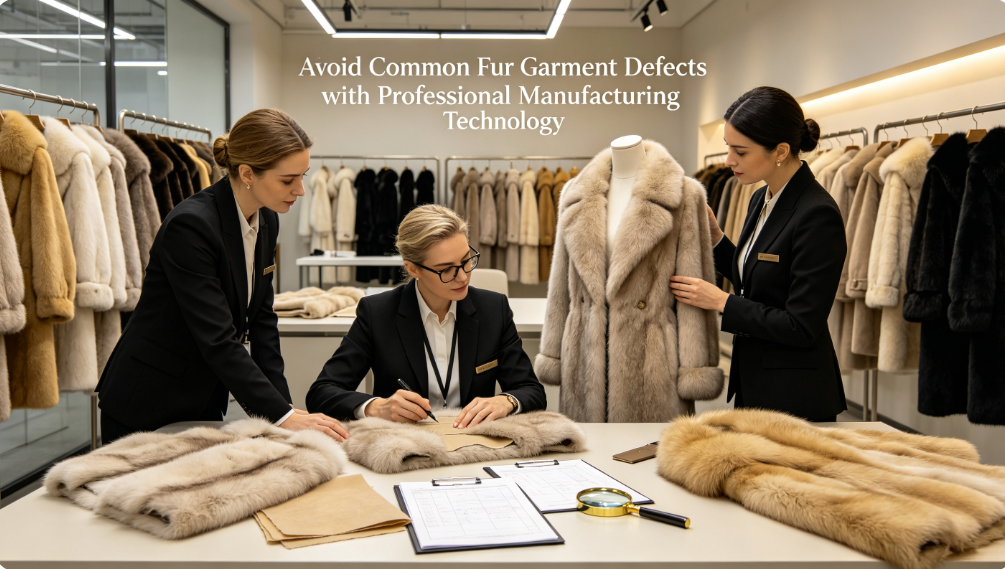
Brand: JSFUR | Official Website: https://www.jsfur.com
Introduction
Luxury real fur and premium faux fur garments rely on sophisticated raw material processing and precise handmade craftsmanship. Even minor procedural negligence during production can lead to persistent quality defects that affect wear experience, market sales, and brand reputation. Most low-grade fur product problems are not caused by post-purchase wear damage, but by unstandardized factory production and incomplete pre-production processing.
Many small-scale fur workshops ignore professional fur tanning, shaping, and stitching standards, resulting in common defects including fur matting, leather base hardening, local bald spots, color fading, stitching deformation, and peculiar odors. These flaws are difficult for ordinary buyers to detect from photos but will trigger large-scale returns and negative reviews after bulk sales.
As a professional luxury fur apparel manufacturer with 15+ years of standardized production experience, JSFUR deeply analyzes the root causes of the six most common fur garment defects in the industry. We share exclusive factory-level processing solutions to explain how formal manufacturers eliminate hidden quality risks from the source, helping global wholesale and custom brand partners obtain zero-defect fur products.
1. Fur Matting & Clumping (Process Defect)
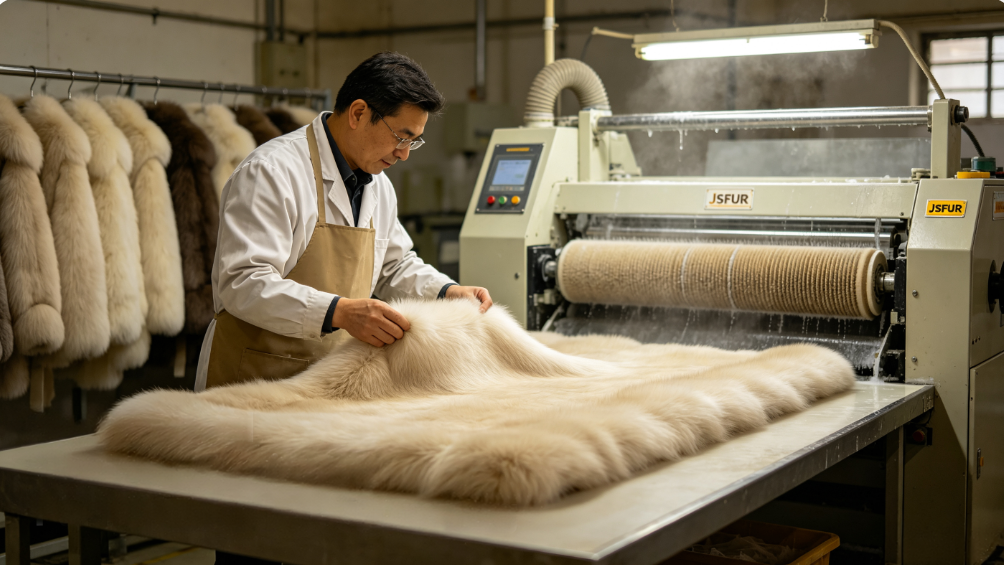
Defect Manifestation: The fur surface is prone to tangling, clumping, and losing fluffiness after slight friction or humid storage. The overall appearance is dull and flat, lacking the fluffy and layered texture of high-end fur garments.
Root Cause: Unprofessional fur degreasing treatment and incomplete post-production shaping. Small workshops save costs by skipping high-standard oil removal and fluffy finishing processes, leaving residual grease on fur roots. Grease accumulation causes fur adhesion and matting over time, especially in humid cross-border transportation and storage environments.
JSFUR Professional Avoidance Solution: We adopt multi-stage low-temperature degreasing and high-frequency fluffy carding technology for all fur raw materials. After sewing and finishing, every garment undergoes manual layered combing and constant-temperature shaping treatment. This process completely removes residual grease between fur roots, maintains long-term fluffy and smooth fur texture, and effectively avoids matting and clumping during transportation, storage, and daily wear.
2. Leather Base Hardening & Cracking (Material Processing Defect)
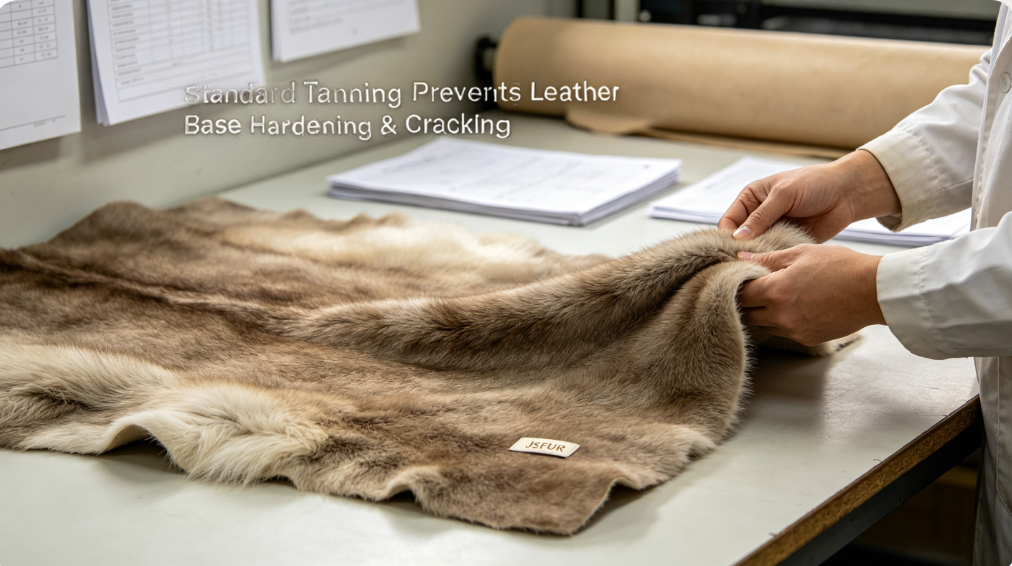
Defect Manifestation: The real fur leather base becomes stiff and brittle after wearing or seasonal storage, prone to dry cracking, edge peeling, and garment deformation. This is the core defect that shortens the service life of fur coats.
Root Cause: Rough tanning process and lack of softening maintenance procedures. Inferior factories use rapid chemical tanning to shorten production cycles, destroying the natural toughness of fur leather. Without secondary softening and anti-aging treatment, the leather base will harden and crack with temperature and humidity changes.
JSFUR Professional Avoidance Solution: JSFUR strictly implements slow and environment-friendly tanning technology. All fur pelts undergo multiple rounds of softening, stretching, and anti-drying treatment. We maintain the natural elasticity and toughness of the leather base, ensuring the fur garment remains soft, foldable, and crack-proof in low-temperature winter environments and long-term storage, greatly extending product service life.
3. Local Bald Spots & Uneven Fur Density (Cutting & Nesting Defect)
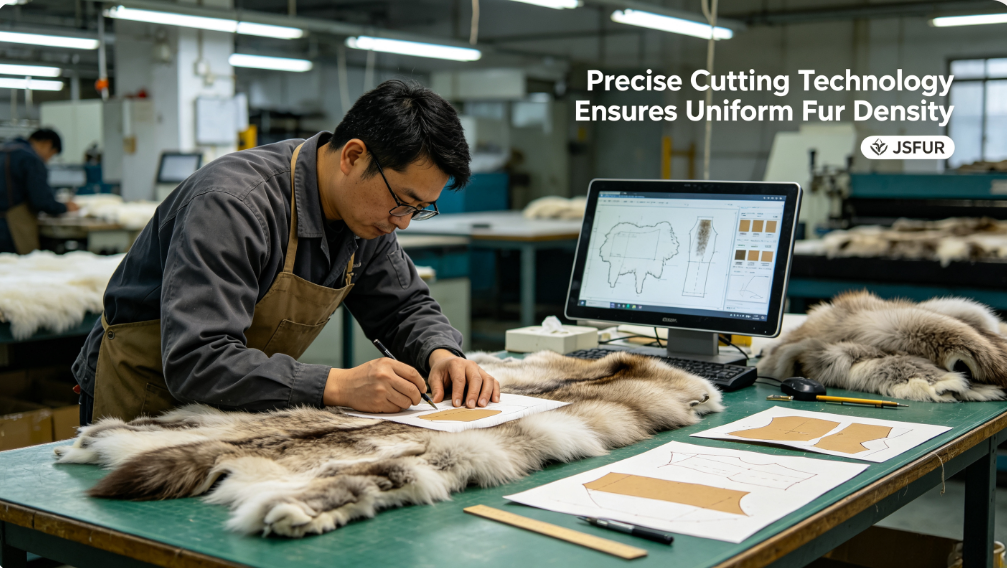
Defect Manifestation: Partial sparse fur, obvious bald patches, and inconsistent density on shoulders, sleeves, and splicing positions, seriously affecting the high-end visual texture of fur garments.
Root Cause: Random manual cutting and unreasonable material nesting. Ordinary factories lack professional fur direction planning and flaw screening mechanisms. They directly cut raw materials without avoiding natural fur flaws and sparse areas, resulting in defective finished products.
JSFUR Professional Avoidance Solution: We adopt AI intelligent nesting combined with senior craftsman manual screening. Before cutting, technicians inspect each pelt one by one, mark natural flaws and sparse areas, and reasonably plan cutting directions and positions. We ensure uniform fur density and consistent hair flow on every visible part of the garment, completely eliminating local bald spots and uneven density defects.
4. Color Fading & Batch Color Difference (Dyeing & Batch Management Defect)
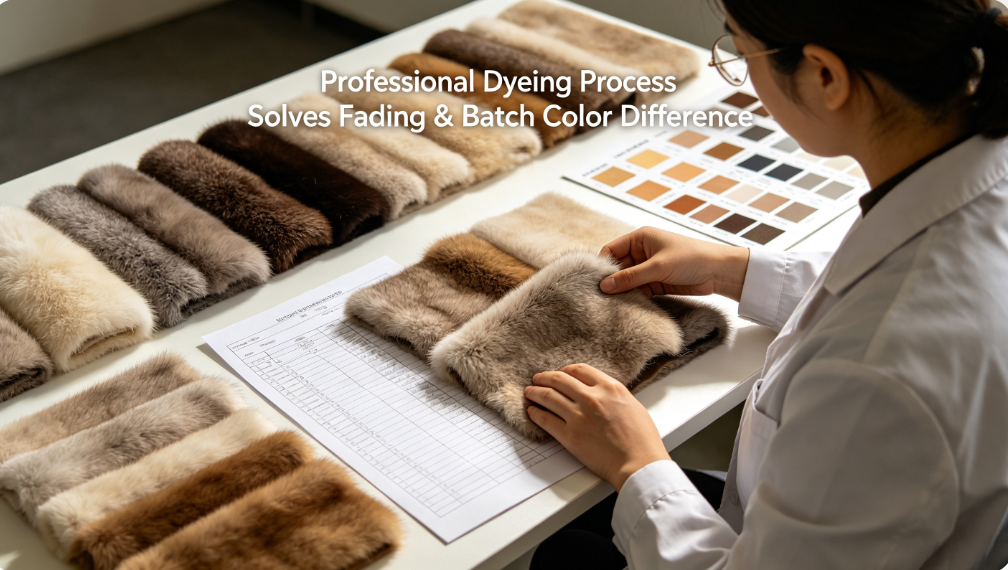
Defect Manifestation: The fur fades after slight friction or damp contact; different batches of bulk orders have obvious color tone deviation, resulting in inconsistent retail inventory style.
Root Cause: Low-quality dye materials, incomplete color fixing process, and mixed-batch raw material usage. Unprofessional factories use inferior dyes to reduce costs and skip high-temperature color fixing procedures. Meanwhile, random mixing of different dye-lot fur materials leads to unavoidable batch color difference.
JSFUR Professional Avoidance Solution: JSFUR uses high-grade environment-friendly fur-specific dyes and implements three-stage high-temperature color fixing technology. All bulk order raw materials are from the same batch and same dye lot. Before delivery, professional color calibration under natural light is carried out to ensure uniform color tone, stable color fastness, and zero batch difference for all finished garments.
5. Splicing Misalignment & Seam Deformation (Tailoring & Sewing Defect)
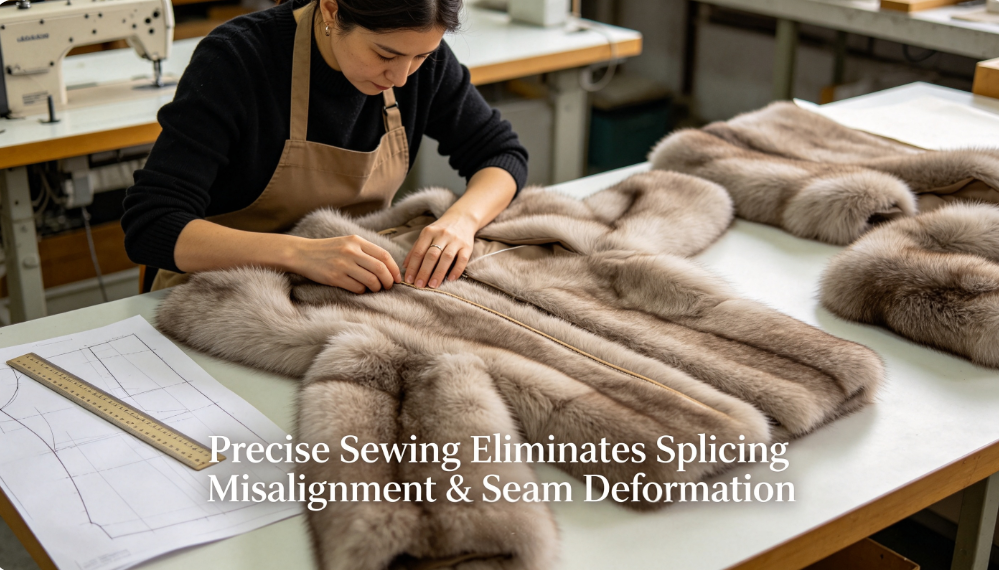
Defect Manifestation: Irregular fur splicing lines, asymmetric left and right structures, loose stitching, and wrinkled seams after wearing, reducing the overall stereoscopic and high-end sense of fur garments.
Root Cause: Low-precision pattern making, uneven stitching density, and lack of semi-finished product calibration. Small workshops rely on inexperienced workers for random sewing without unified stitching standards and secondary shape correction.
JSFUR Professional Avoidance Solution: We adopt high-precision CAD pattern grading and unified standard stitching density. Senior fur-specific craftsmen complete splicing and sewing, with strict one-by-one calibration of symmetry and flatness. After sewing, semi-finished products undergo hot shaping and wrinkle removal treatment to ensure flat seams, neat lines, and three-dimensional and stereoscopic garment tailoring.
6. Residual Peculiar Odor (Tanning & Finishing Defect)
Defect Manifestation: The finished fur garment has obvious fishy, chemical, or mildew odor, which cannot be eliminated by ventilation and seriously affects customer experience.
Root Cause: Unqualified tanning agents, incomplete deodorization process, and humid production and storage environment. Inferior factories use low-cost chemical tanning materials, and residual volatile substances form persistent peculiar odors.
JSFUR Professional Avoidance Solution: JSFUR uses food-grade environment-friendly tanning auxiliaries and adds professional deodorization and purification procedures in the post-production stage. All finished garments are stored in constant-temperature and dry dust-free workshops. We strictly control residual chemical substances and mildew risks, ensuring every delivered fur garment has no peculiar odor and meets international environmental protection and safety standards.
Why Professional Factory Standards Eliminate 99% of Fur Defects
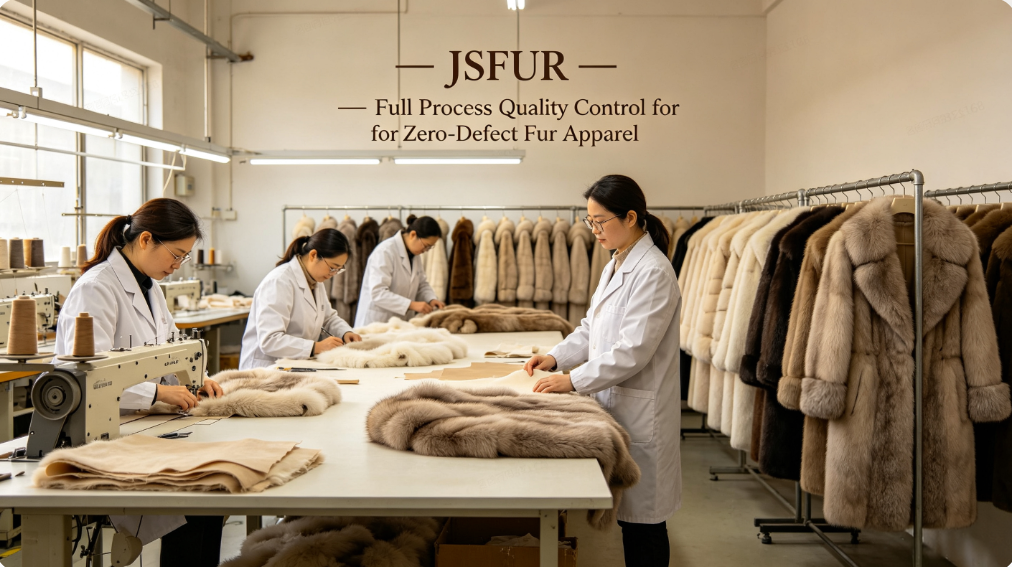
Almost all common fur garment defects are artificial and avoidable, stemming from cost-cutting processes, unskilled craftsmanship, and imperfect quality control systems. As a standardized luxury fur manufacturer, JSFUR builds a full-process defect prevention system different from small workshops:
• Raw material pre-processing mechanism: Unified degreasing, softening, flaw screening before production to block source defects
• AI + manual precise cutting: Avoid density unevenness and structural flaws caused by random cutting
• Standardized craft parameters: Fixed stitching density, color fixing temperature, and shaping time to eliminate process errors
• Three-layer QC inspection: Pre-production, mid-production, and finished-product full inspection to intercept defective products
• Constant-temperature finished product storage: Prevent odor, mildew, and deformation during storage
Conclusion
Common fur garment defects are never unavoidable industry problems, but quality loopholes caused by non-standard production. Low-end suppliers focus on low prices and cut key production processes, while professional manufacturers like JSFUR eliminate hidden quality risks through standardized pre-processing, precise craftsmanship, and strict quality control.
For winter fashion wholesale and custom brands, choosing a factory with complete defect prevention systems is the core premise of stable high-quality supply. JSFUR always adheres to refined production standards, providing global clients with zero-defect luxury real fur and faux fur apparel OEM/ODM and wholesale services.
Get stable zero-defect fur garment supply and custom service: https://www.jsfur.com
Share this article